We Need Protests and Courage Now

Some say we are sliding into autocracy. I disagree. Welcome to the new autocratic power structure where the US Constitution, the Rule ofLaw, and established norms (let alone civility) no longer govern our lives.

Congress is no longer an equal branch of government. The Federal government has been shut down indefinitely. Federal workers are not getting paid. Some are getting terminated illegally. Disguised ICE agents are threatening, capturing and detaining citizens without warrants. Medicaid is being gutted. And the Supreme Court seemingly has abandoned precedent. Freedom of the press — the 4th Estate — has been evicted from the Pentagon.

Oddly, at the community level democracy still goes on unabated.

The City Council meets. The economy hums. Kids go off to college. The World Series fills stadiums. Restaurants are busy. Mail gets delivered. The Washington Post arrives each morning. Many of us can easily say I’m okay and my family is okay. Not much of the bad news affects us yet. But, a lot of us are not okay, especially if your skin is black, brown or tan, or you’re poor, furloughed or have been fired.

We are living in two worlds, and the juxtaposition is crazy making. The US Constitution is being shredded and trampled while we sleep. 

Like many of us, I am deeply frustrated and disappointed in the efforts of the national Democratic party to rally citizens to the cause of liberal democracy. The time has come to give the little guy — the so-called average voter — a fair shot to help build the case for resistance. We citizens (and would-be citizens) want leaders. We want to speak out and be heard, to protest, to vent our anger and fears over the retrograde direction which President Trump and the Republican Party are unshamefully leading us. But there has been almost no way to do so. Collectively we say to ourselves, “What can I do? What can we do?”

Let me answer. 

In the quiet conversations with friends and family I hear “I’m scared” regularly. Many say they simply don’t want to even bring up the subject in casual conversation because it is so unsettling. Despair and helplessness are feelings I hear expressed repeatedly. Partly, it’s not knowing what else to say that hasn’t already been said.

Some say they no longer watch the news because it’s unnerving. Guest experts on TV news shows debate ad nauseam nuances of the law; speculate on what President Trump will do next about what-ifs; ponder on the Democrat leadership void; psychoanalyze Trump; fret over the Supreme Court, or promote a guest’s new book. To what avail?

Republican leaders apparently don’t care. For Republicans, the rule of law is like a Metro turnstile that only turns in one direction: to the right. Interestingly, as it turns out, a large portion of the electorate also seems not to care. Why is that? Well, for one thing, look at the stock market. The past 6 months the S&P 500 has climbed 26%; the NASDAQ is up 39%. A lot of people are feeling pretty good watching their 401Ks get fat.

Most discouraging to me, all day long my iPhone pings messages from random Democrats running for office, begging for money and making incredible assertions that my dollar will make the difference. Democrats tout polls that show Trump’s decline in popularity. But polls do not matter to an autocrat. 

I used to think, well, let’s just wait a while and the tide will turn, and Mr. Trump will find himself back pedaling. Ain’t happening yet. Maybe tomorrow? Or next month? Who knows?

What frustrates me: I look back to the late 1960’s when society was rent over the falsehoods promulgated by the administrations of Kennedy, Johnson and Nixon — the Best and the Brightest as anointed by David Halberstam — over our progress in winning the Vietnam War. People protested loudly and often.

Me and millions of boys and men lived with the prospect of the draft. Cornell University like other colleges was a hotbed of protests and teach-ins. In 1967 a massive spontaneous march of over 50,000 protested in front of the Pentagon. 1968 was a time of urban riots, political turbulence, and mass civil unrest particularly culminating in the Democratic National Convention in Chicago. As for my then wife and I, having a newborn, we could only watch and wonder.

In retrospect, with the murders of Martin Luther King Jr. and Robert Kennedy among other setbacks, 1968 was the worst year of my life. King’s assassination reignited cataclysmic riots in Chicago, Washington DC, and Baltimore. For the past 57 years I believed that 1968 was the worst year in modern American history. 

But no longer. We now have a president who is undoing what our fathers, uncles and granddads died for on Pacific beaches, the deserts of North Africa and the D-Day assault that led to over 10,000 casualties including 4,400 dead in one day.

Trump does not know about the extreme sacrifices Americans have made to preserve democracy here and abroad, nor does he care. For those who died in combat Trump calls them suckers. 

So, there’s one way — and only one way — to deal with the despair so many of us feel.

We cannot wait on the court system or the next election (if there is one). We need to do what always has worked as far back as the Battles of Lexington and Concord, and it will work again. Simply, we have to get off our collective butts and go out into the streets. All of us! We need to do what Martin Luther King Jr. taught us. Non-violent protests work. The reason is that opponents don’t know how to respond, except with force. 

All of us need to fill the streets and the plazas with our warm bodies. In March 2017 a million people showed up on the Mall to demonstrate for women’s rights. My daughter and I were there. No one was injured and our feeling was exhilaration, community and pride. Many hundreds of thousands that day demonstrated in cities across the country.

This year alone gigantic demonstrations have toppled dictators in Nepal and Bangladesh, just this week in Madagascar. In our own country think of the times when Republican congressmen have held town-hall meetings but find themselves confronted and shouted down by angry voters, forcing the representative to escape out the back door.

Big and persistent demonstrations like this shiver the timbers of those hoping to hold on to their cherished political power. They run out of excuses and half-assed justifications. All the campaign cash in the world is not going to help.

I grew up in the Deep South when apartheid ruled. It was so ingrained almost no one thought it was wrong. I grew up hearing, “The races get along; the Negroes know their place.” (And they did.) I witnessed the Ku Klux Klan members do their thing. I got used to hearing the N word and singing “Dixie”with enthusiasm. But I also heard MLK Jr speak, and learned about Rosa Parks. I and my young pals found it hard to reconcile what this meant. By 1965 when Dr. King marched across the Edmund Pettus bridge in Selma blood was spilled and the Voting Rights Act became law..

Non-violence inevitably will eventually provoke violence. The right wing crazies don’t know how else to respond. We see it today with Trumps’s ICE agents. Peaceful protests are not always safe. It requires leaving our respective comfort zones, bravery and persistence. It is not for cowards. Change happens slowly but surely. 

I know that it will work because it always has. Dr. King knew this. What we are doing is urgent if we want to save our America for our children. 

But here’s the main thing to understand: Out of these demonstrations, big or small, we build community, a powerful sense of togetherness and strength. We motivate our political leaders, judges and justices to stand their ground and fight harder to save our Bill of Rights. Courage becomes contagious.

This Saturday October 18 from 11:00 a.m. to 1:00 a nationwide NO KINGS protest takes place in Takoma Park. Millions are expected to participate across America. I see it, however, as just a start. It needs to keep happening and not just on Saturdays. That’s because Mr. Trump and his minions will brush it off as fake and contrived. They have already started. It’s not going to be easy.

Whither Piney Branch School?

The Piney Branch Elementary School (PBES) on Maple Avenue is obsolete, deteriorating and dysfunctional. It’s time for it to be torn down and replaced. No half measures will do. 

Fortunately, on June 30, 2025 the Takoma Park City Council adopted a resolution recommending to Montgomery County’s Board of Education to do just that: to build a new Piney Branch School on the same site and keeping the swimming pool. The City Council has done its job representing the wishes of residents. Ultimately, what gets built and when is the County’s decision and expense.

Alas, less fortunately the suggested conceptual design for the new school building is not especially imaginative. It falls well short of what is effectively an urban, high density school site. In fact, I was shocked by the amount of land given over to an asphalt parking lot right on Maple Avenue.

First, let’s go back in time to understand what we have. Built 54 years ago, opening in 1971, PBES was then one of the County’s few middle schools serving grades 5 to 7. Oddly, it had a swimming pool but no playground. Built on the smallest of all county school sites, MCPS must have been desperate. Lucky Takoma Park.

The school’s architectural style is a kind of “Brutalism” that was  popular in midcentury. The style emphasized flat, bare brick (or concrete) facades, glass and excluded any decorative design features, colors, and human scale aspects. The school is rather remindful of a detention center. 

The incredibly constrained 1.9 acre site forced an awkward, multilevel arrangement of odd-sized teaching spaces, some with no daylight, and a byzantine interior circulation pattern. PBES was an ugly duckling from the day it was conceived.

For several years MCPS has been looking for a way to increase the school’s capacity by adding classrooms. Climbing attendance pressures have necessitated a quest for finding more space. Finally, with the adoption of the Minor Master Plan Amendment earlier this year, MCPS was able to launch a serious feasibility study of the future of Piney Branch. Serious because this study has meant a commitment to resolving this issue.

The County hired an architecture firm, Stantec, to conduct a series of community meetings basically to test out various schemes for the school’s future, and to obtain residents’ opinions on the matter. The design team presented its findings to the City Council July 23.

Predictably, the design team’s presentation took the form of describing three different remodeling solutions and a fourth one that would build a new school from the ground up, each with and without a pool. It seemed painfully obvious to me that doing a partial renovation would be simply trying to make a silk purse out of a sow’s ear. It is not like the building is an architectural gem or has any redeeming sentimentality attached to it.

Stantec had not yet completed a cost projection of any of the proposed plans at time of its presentation. But experienced developers know that large scale restoration and renovation almost always costs more than new construction. That’s because of the many unknowns that make it nearly impossible to accurately predict costs.

Engineers cannot know what lies inside the walls. Infrastructure cannot be replaced piecemeal. Whole energy and HVAC systems have to be replaced including the water supply and plumbing systems. Stuff built in another century decays and wears out. Technology becomes mechanically and environmentally obsolete.

We now live in a digital world.  Back in 1971 people were still using typewriters, dial telephones, and found services in the Yellow Pages. School teachers stood in front of blackboards armed with chalk and erasers. 

Deficiencies enumerated by Stantec include:

  • classrooms that can be entered only by passing through another classroom
  • a playground accessed by outdoor stairs –33 steps to be exact
  • numerous complex ADA violations
  • leaking pipes throughout, rain coming in during heavy storms
  • limited or no natural light in some rooms
  • inefficient mechanical systems
  • insufficient parking
  • unacceptable conflicts between  parental drop offs and bus offloading
  • even the pool’s equipment needs upgrading. The list goes on.
It is not like the building is an architectural gem or has any redeeming sentimentality attached to it.

Renovation and various additions could not address all of the core issues embedded in the building. There’s significant risk that renovation would cost much more than new construction.

Even if costs were identical, why would we want to do all this work and still end up with an old and aging building, and an ugly one at that?

It also should be obvious that the project requires inclusion of a new swimming pool. Stantec’s proposed concept design shows that a community accessible pool can be accommodated on the site.

A city of Takoma Park’s size needs to have its own public pool for residents. It’s an essential component of a heathy lifestyle for all ages where one can soak, socialize, swim laps or learn to swim. Many lower income residents lack the means to join expensive pool clubs that typically cost well over $500/year. The Lunch and Learn organization (of which I am a board member) has taught hundreds (if not more than a thousand) black, brown and tan kids the joys of swimming.

In the final analysis, Stantec’s concept plan fails to consider a way to greatly reduce the land area dedicated to parking. Maple Avenue represents the formal heart of Takoma Park, serving the city’s Community Center and city offices, the new library, the indoor swimming pool, two public schools, and numerous apartment towers.

The Minor Master Plan Amendment adopted this year calls for Maple Avenue to become a “Green Promenade”. Stantec seems to have given it little, if any, regard because the whole front of the property along Maple Avenue shows a parking lot for staff.

To quote the Minor Master Plan: 

“The Green Promenade provides a unique opportunity to repurpose lands that would ordinarily lie undeveloped. The Promenade offers environmental benefits and educational, cultural interpretation, and social opportunities and a quality outdoor amenity attracting and benefiting residents and visitors alike. In its ultimate implementation, the green promenade will be a multi-functional pedestrian space with wide shaded sidewalks, street trees, curbside stormwater management, and places for residents to sit and gather. It will be a green link to Sligo Creek and Long Branch Stream Valley Parks and potential new green space on the Washington Adventist campus.”

There are 33 steps from the rear exit to the playground

There is at least one solution that begs consideration, which would honor the Master Plan. It is to elevate the future school building (not the pool or the gym) above the parking lot, so that cars can park beneath it. This would also make the school’s first floor be level with the uphill playground to the rear so that children don’t have to climb 33 steps to play. It’s a safety consideration that will benefit kids with disabilities. Kids, staff and visitors will enter the school from below by stairs and elevator, and avoid rain and snow. Perhaps not all the parking can fit under the school, but green space along Maple Avenue can be greatly enlarged adding hugely to the loveliness of the school’s setting and entry way.

Stantec’s proposed parking lot is not a good look. It is just more of the same! Maple Avenue is already lined with acres of parking lots. As a 1.9 acre high-density, urban school site, the project demands innovation. It is way too small for a suburban parking lot. It won’t come cheap of course. To achieve the “Green Promenade” vision unconventional solutions have to be employed and dollars spent.

Who Should I Vote For: 7 Pointers

It might be a bit of a challenge to figure out who to vote for in the upcoming November 5 election. Maybe I can help you to decide.

I’m talking about the Takoma Park city election, not the Presidential and Congressional elections. (By the way, the two elections are physically separate, so do both.)

Historically In Takoma Park — at least as far as I can recall — city elections have usually been rather ho-hum affairs because incumbents like to keep their seats and sometimes challengers are scant. But not this year!  This year early registrations reveal that at least three of the ward seats, maybe more, will be vigorously contested. 

We won’t know the complete candidate list until the September 10 nominating caucus, which determines who is on the ballot for mayor and each of the six wards. 

So who will you vote for?  How do you decide?

I am not here profiling candidates, naming names or arguing issues. Instead, I hope to explain what to look for in a candidate while also having reasonable expectations. I served four terms on the city council and in that time worked side by side with 13 different council colleagues including two mayors. Some were better than others. I know what makes a good Takoma Park Councilmember. 

Here are 7 pointers to think about as you plan your vote.

1) To start, understand the council job is tough for two reasons. It is truly time consuming and there is a very steep learning curve when you are new. Add to that, you are taking on an ongoing complex agenda. If you will, think of it as grabbing onto a slow moving freight train. 

I came to the council in 2009 newly retired from the field of commercial lending. But that did not prepare me for coping with the city budget, much less how to critique it. In truth it takes at least a year or two to really find your footing. 

My advice: Have patience with a new would-be councilmembers. 

2) The task of a councilmember is less about a member’s personal agenda and more about working collegially with the other six folks sitting beside you on the dais. It took me awhile to appreciate a simple fact: no matter how powerfully I felt about an issue or an idea, I had only one vote out of seven. Councilmembers have to engage with each other, not just sound off to attract attention. 

My advice: So when a candidate says how they are going to change things, take it with a grain of salt. 

3) One of the nice things about our town is city government small enough that as a councilmember you quickly get to know the department heads and some of their top staff. Of course, the city manager and executive staff are expected to follow the City Council’s lead on policies and strategies. In return, you are totally dependent on professional staff to show you the nuts and bolts of running a city and serving residents 365 days a year. A good councilmember, particularly someone new, needs to be a good listener, and unhesitatingly asking questions like how and why.

Incumbents in an election have a natural advantage, but that only helps them if they’ve done a good job. A candidate who has previously served on a city committee, commission or task force is a plus.

My advice:  Don’t expect new candidates to have all the answers. At least not right away. 

4) An often overlooked piece of a councilmember’s job is getting well acquainted with other municipal officials in Montgomery County, with members of our Annapolis delegation and the role of the Maryland Municipal League, which serves Maryland’s 157 cities and towns. Helping getting legislation passed in Annapolis and coordinating with Montgomery County are essential duties. It can actually be one of the more fascinating aspects of your position. Typically, it involves testifying to committees in Annapolis when the Assembly is in session. The same with the Montgomery County Council. Helping to lobby on proposed laws. In the process you learn the ins and outs of legislation and get to know many smart decision leaders.

My advice:  Listen to what candidates may know and say about big picture issues.

5) When I first got on the Council some of my colleagues felt it was their job to rudely admonish staff members at council meetings. It’s wrong and unnecessary. In that respect, I worked many years for Baltimore City and Arlington County as a planner and in small business development. It’s dreadful to be publicly dressed down. There are plenty of other ways to get your message across, such as meeting and discussing issues with the City Manager and any key staff. For what it may be worth, my first principle was to try to make things easier for staff to do their job.

My advice: If a candidate seems prone to overly faulting city staff, think twice choosing who to vote for. 

6) When I was on the City Council the opportunity to respond to my constituents’ complaints and needs was the most rewarding part of my job. Folks don’t forget. Not all, but most problems can be easily fixed, like a broken street lamp, a missing street sign, a house fallen into disrepair, a noise complaint between neighbors, or a street that didn’t get plowed. There’s no glory in it, and while it’s true some people are chronic grouches, it is the essence of representation. 

My advice: Ask candidates about their views on how they would address problems that bother you.

7) Councilmembers differ on the extent to which they communicate to folks in their wards. Some do this well with a  periodic “newsletter,” a Facebook page (or other social media), email blasts, etc. Some like to host mini-meets with neighborhood activists. (I did several of these things.) It can be difficult to connect to renters and those who live in apartment buildings and condos. Councilmembers have to figure it out for themselves. 

An unfortunate problem is the complete lack of local print media in our area. Once upon a time there was the Takoma Voice, a monthly rag full of photography, ads, articles and commentary that kept residents well informed. As a printed newspaper it ended in 2012. It’s sorely missed. The City’s Newsletter does a great job, but it’s largely limited to city government business. Thus, it falls to individual councilmembers to inform their constituents as best they see fit. 

My advice: Ask candidates whether and how they plan to communicate with you and your neighbors. 

Finally, being a Councilmember is often described as a thankless job. Wrong! I got plenty of thank-you’s and respect. Too, it’s a bit of an ego trip. The City Council after all, leads a city; a city that has “shown the way” to many other municipalities in Maryland and America. After a 42-year professional career, becoming a politician proved, unexpectedly, to be one of the most interesting and challenging jobs.

Robert DiSpirito, city manager

                The selection of Robert DiSpirito to be Takoma Park’s new city manager is welcomed news for a somewhat dispirited city government. What the professionals in our city government –– the department heads, division managers and others who are paid well for their acumen and institutional memory –– have needed and missed for a long time is stability at the top. 

                He will bring that, plus leadership based on his extensive experience, and the ability to make timely decisions to get things moving.

Last month I accepted an appointment to serve on a candidate interview committee representing various standing city committees. (In my case, the Police Chief’s Advisory Board.) We were given an hour with each of the final three candidates, after which we forwarded are opinions anonymously to the city clerk. 

Mr. DiSpirito was new to me, notwithstanding his recent tenure with Rockville. Having interviewed city manager candidates twice during my time on the City Council, I came away unequivocally convinced he was the best choice, a good choice and the city would be truly lucky to have him. I am delighted with the Council’s decision.

Over the past 30 months Takoma Park has endured unexpected and uncharacteristic turmoil. Much of it has been internal to our city government, notably since the retirement in mid 2021 of then city manager, Suzie Ludlow. Ms. Ludlow served as deputy CM for several years before becoming city manager herself in 2015. A prior nation-wide search produced her replacement, Jamal Fox, who immediately took the reins. Unfortunately, Mr. Fox lasted only 18 months before abruptly resigning for reasons never publicly revealed. 

City Council quickly appointed two senior veteran staffers to temporarily fill the breach as “acting deputy” CMs. Then a month or so later David Eubanks, having worked for the city two years, agreed to hold the fort while the City Council launched another nationwide search. 

The City’s carefully wrought plans for a 2-level retail center on a city parking lot at Takoma Junction had by 2022 undergone 8 years of community review and criticism. The City Council decided, suddenly and inexplicitly, to reverse course and scuttle the whole thing. The city’s community development staff saw years of planning and study go up in smoke, among recriminations on all sides. Residents were left to wonder what went wrong.

Meanwhile, the near universally supported library renovation and expansion project bogged itself down in environmental flood plain issues. What started as a renovation and expansion plan of a 60 year old structure had to be converted to a total “demo” and ground-up rebuild. Estimated project costs rose. (It’s now underway.)

These events were backdropped by the pandemic forcing most of the city’s executive staff to work from home. Unlike, say, at software engineering firms and federal agencies, in a small municipality remote work is counterproductive where decision making relies on staff proximity.

The American Rescue Plan Act (ARPA) suddenly brought a gusher of $17.5 million in unexpected funds to the city. (That equals about half of the city’s normal budget.) While it was welcomed and needed, it had to be quickly allocated and encumbered within a deadline, or sacrificed.

Action on hoped-for plans to replace the aging rec center on New Hampshire Avenue with possible new housing, lost traction, possibly of necessity.

The Purple Line’s interminable construction delays and chaos have sparked massive commuter cut-thru’s and stressed the local economy. This, paired with the abandonment of the former Adventist Hospital and all of its outbuildings (see More Than Housing) has produced the opposite of economic development. Call it “undevelopment”. These days the future of a lot of stuff seems lost in the mists.   

This is the setting as Richard DiSpirito arrives on the scene.

The City’s official statement on his hiring describes his career background. In August he resigned his city manager position with Rockville after seven years. The fact that he lives in Montgomery County, and his family has two kids in MCPS, and he knows Montgomery County and Maryland politicians are huge pluses. He knows and has interacted with some of our city’s staff. 

From the interview I was impressed that DiSpirito’s views on policing exactly mesh with our Chief Antonio DeVaul’s philosophy on hiring, diversity and maintaining public safety. He is familiar with Takoma Park’s unique character, what some might call the city’s zeitgeist. He spoke to our interview panel about his preference to “ride with city workers” as they do their jobs. Doing so, he said, has inevitably helped him better understand workers’ challenges. 

In like manner, he likes to get out into the community and meet residents in person. That may not sound like a special attribute. Actually, it’s remarkable. In my 38 years here, I don’t recall any city manager seeking to routinely meet residents where they live. 

In discussing his work with Rockville he referred to successful economic development efforts. I asked DiSpirito about the long, unrealized redevelopment opportunities along New Hampshire Ave. To my surprise he’s already aware of the situation and said he would want to pull together all the interested parties [presumably property owners, business owners and planners] in order to figure out a strategy. For me personally, this was music to my ears as an economic development pro.

The New Hampshire Ave corridor holds a huge latent potential for future housing, businesses and retail services all of which will expand our tax base. It just needs to be exploited. There are developers who want to do so.

In person, DiSpirito is soft spoken, polite, and chooses his words carefully. He seems open to listening, which of course is helpful in an interview. But he seems to speak with a level of assurance that comes from a deep well of experience. 

It should be noted, as a city manager you are, of course, answerable to the politicians who hired you, which is never easy. After the first city election you are likely answerable to some who didn’t hire you. So, tact, responsiveness, listening well, and being said no to become part of a city manager’s skills. 

It may take a little while. Restoring stability and a sense of direction will bring about heightened morale in our town’s government, and hopefully true economic development.  

Despite the pandemic, staff turnover, budget disruptions, a relocated library and other challenges, the city has performed its services — stuff we take for granted — to residents without disruption. That’s a big deal. In that light, kudos go to all those who’ve “kept the trains running on time” including acting deputy CM David Eubanks. 

More Than Housing

Choosing the Future of the Hospital Site

Washington Adventist University Commons

Bickering . . .

It’s already begun. The vacated Washington Adventist Hospital campus confronts us with an exciting and perhaps daunting once-in-a-century revitalization opportunity. Barely into the public hearing phase, bickering and confusion among residents have already broken out.

I have the strong feeling that all of this so-called “planning” that’s been done so far is being done backwards. Zoning, which neighbors are fretting about, is NOT how we should start. Zoning is a government regulatory tool that has a role to play at some point down the road. But zoning does not accomplish anything. It doesn’t give direction. It does not provide inspiration. Zoning does not and cannot make anything happen. 

Dealing with zoning at this nascent stage is putting the cart in front of the horse. It’s like the husband asking the wife what wallpaper they want in the master bedroom when they haven’t even bought the house. Too prescriptive zoning forecloses possibilities. Too broad zoning designations risk making residents exceedingly nervous. 

Montgomery County’s professional planners are doing no one a favor by making such a big deal out of zoning. The Takoma Park City Council should not be forced to effectively make zoning decisions even though this is formally done by the Planning Board. That is cruel and unusual punishment to put councilmembers through. I speak from experience.

The old main WAH hospital building

Instead, let’s cool the debate and start at the beginning.

What once had been a revered institution, a kind of “grande dame” of hospital care in the Washington region, saw its doors close in 2019. Abandonment came amid broken pledges for continuity of medical services; and so ended Takoma Park’s dominant employer.

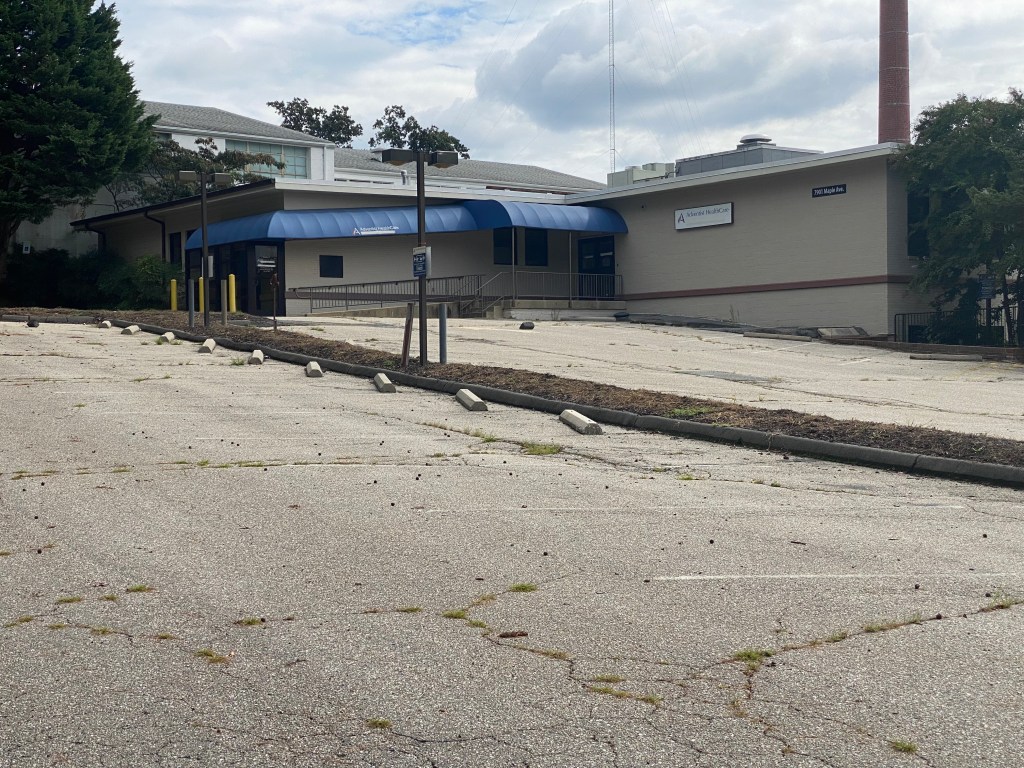
What we are left with is this large acreage containing a huge, virtually empty hospital. Next to it, there’s an empty 3-level parking garage. Interspersed among empty parking lots, I count three boarded up ancillary buildings. There’s a former “women’s health center”/conference center; another very old building labeled “Eisner;” and a doctors’ office building. Plus a heating plant which is operating.

When I look at the main structures, my first thought is Environmental Hazard.

A Lovers Leap

Of grave importance, to the rear of most of these buildings runs a crumbling, caving (not kidding) service road that hangs on the precipice of a near vertical slope into Sligo Creek. (Kind of a lovers’ leap since there are no guard rails.) This is ominous because construction and mechanical engineers will have to play a featured role in the dismantling of the hospital buildings and the design of any new structures proximate to the ravine.

On the subject of demolition, it may cost a couple million dollars to demolish these structures and remove hazardous materials, doing so in a way not to harm the creek. This means any future development proposals by private parties will have to account for the financing of these costs. This unique cost burden (as opposed to developing a clear site) complicates the site’s future.

Former Adventist doctors’ offices

East of the access road lies the large, lovely greensward with big trees – WAU Commons — whose sole purpose apparently is to grace the WAU campus. It seems to be rarely used for outdoor functions.

Most people, including me, have no idea what this collected mishmash of structures, the greensward, empty parking lots and access road, possibly purports to serve.

Who actually holds title to it or its various pieces, and who maintains it all? Is the nameless road that traverses all these spaces, public or private? 

Who Gets to Decide?

Given present circumstances, we can reasonably surmise that until someone or some entity takes charge, it may sit there and just rot. What or who will that be?

I am concerned that given Takoma Park’s penchant for opting for the do-nothing alternative, that is not an unlikely outcome. Do-nothing is obviously not an option here.

Old, boarded Lisner building

On the bright side there appears to be consensus that this large piece of Takoma Park situated at the city’s epicenter presents an unprecedented opportunity, especially in a town of just 2.2 square miles. The possibilities for its reuse challenge our imaginations. 

There’s a lot of talk about the need for “affordable housing,” the definition of which seems to depend on who you are listening to. As recently as three years ago, purposes such as a health campus under Adventist Health Services’ aegis, or a new elementary school, or an aquatic center, or an expansion of the University were batted around. But those schemes seem to have receded from the conversation. 

Nowadays, it’s more about “mixed uses” which, to me, translates to some combination of multi-family housing and neighborhood retail services plus public spaces, the latter having a dozen interpretations. 

Depending on how the site’s boundaries are defined, the site may be large enough not just for multi-family housing, but many other functions including shops (like a small grocery, sub shop, café), childcare services, professional offices, indoor and outdoor functions including pop-up opportunities, and decorative gardens. Maybe spaces for WAU classrooms and faculty offices.

A Ready-Made Community

I’d like to take a step back and propose a bigger picture, and consider something exciting.

Rather than wrangle over these individual components, let’s imagine more of a self-contained community that is more than just housing. Why is it when big apartment towers are built, they almost always stand alone, bereft of necessary, convenient stores? Look around Takoma Park, for example. Isn’t that the case? (It may not be hard to guess the answer.)

If we are going to build a lot of multi-family housing — regardless of the income targets — it’s better to provide for those essential stores and services that occupants of any income level will always need, and to do it simultaneously.

Call it a ready-made community. So, when residents buy or rent a unit, they can immediately access space for remote work, or shareable work spaces and studio spaces. But also child care services, places to buy essential groceries, get a haircut and or your nails done, community spaces for meetings, a place to play games, relax and make friends.

In this manner the old codgers, young families, singles, college students and disabled folks can experience each other. A mélange of ages and stages. It also means fewer car trips for routine necessities. 

As elderly persons living in Takoma Park, my wife and I know there’s no such living arrangement around these parts. Not everyone wants to live in a Riderwood-type of “senior” housing where everybody is old or really old. 

There’s an inevitable need for parking of course. One answer might be underground. The slope down to Maple Avenue could enable the construction of underground parking. As an aside, I note that the Eastern Market Metro Station has below-ground parking and a Trader Joe’s. It was packed when I was there in August. (Just a thought.) Or perhaps the existing 3-level parking garage can be salvaged.

Together doesn’t all this sound like a mini town center?

Who’s in Charge?

We as a community can set the direction for the future of this site. The catch word here is “community.” Of course, the process requires local residents’ role to assure our values are protected. This is a complicated challenge with great potential and a lot of issues that need to be researched and answered. The city does not own or in any way control this site. The city’s role should be to help coordinate this process in conjunction with Montgomery County planning staff, the University and/or the SDA.

It’s going to require consultation with outside Specialists, some who may participate as community members; others may need to be hired. One of the first decisions is determining who will take charge of this process. Normally, this would be the property owner who, I assume, but don’t know, is some component of the Seventh Day Adventist Church. Does the City or the County know the owner’s intent or capacity to manage a complex multi-year process? Or even whether they want to retain ownership?

Specialists include those who understand the financial and engineering challenges this site faces. That means architects, builders, landscape designers, and engineers: creative geniuses who can help expand our imaginations for the best uses for the site, while keeping the ambitions with the realm of feasibility. 

I for one don’t want to sit in a room of well-intentioned residents arguing with each over the future of the site; only to come up with some sort of plan that no developer in his right mind will be able to undertake and be successful.

In fact, the whole thing may require a combination of development entities including for-profit and non-profit entities, ones which specialize in housing, in commercial spaces, or in what is known as “place-making.” Our best chance is to devise a whole-cloth development scheme, and to avoid a piecemeal approach that will never reach completion.

In planning parlance, this approach is sometimes called a “planned unit development.” When we get this big picture figured out, then THAT will be the time to make zoning decisions: ones that will not foreclose innovation and will fit the situation.

This approach will take time and be a lot of hard work for our city staff and residents who want to get involved. 

The wide scope of possibilities for the hospital site points the way to proceed. Let’s pull out and dust off the proverbial drawing board and get started. 

Erwin H. Mack, R.I.P. – an homage

I don’t actually remember when I first met Erwin Mack. Likely it was in his capacity as executive director of the Takoma-Langley Crossroads Development Authority (“CDA”), and I was a newly christened city council member. In the intervening 15 years I came to know an extraordinary man.  

When I first met Erwin Mack I don’t actually remember. Likely it was in his capacity as executive director of the CDA, the Takoma-Langley Crossroads Development Authority, and I was a newly christened city council member. 

In the intervening 14 years I came to know an extraordinary man.  

I think his extraordinariness came from the combination of Erwin’s leadership in the Seventh Day Adventist Church’s Potomac Conference and his thoroughly secular understanding of the world of small business and government bureaucracy.

Yet this barely explains the man. While passionately serious in his work, many will remember Erwin’s ready smile and gently teasing sense of humor, which helped disarm many, shall we say, who were good at saying no. This didn’t mean a “no” got converted to a “yes”, but it always opened doors and kept them open.

A case in point were various supplications Erwin and I made to State Highway Administration’s District 3 engineer to build sidewalks and improve traffic safety on Carroll Avenue in front of Takoma Academy in my ward. We got nowhere. Always gracious, these meetings gave new meaning to the word futility that, regrettably, has outlasted Erwin. 

Because I represented the heavily commercialized Ward Six and had a background in redevelopment, Erwin and I found ourselves working on numerous projects, most of which related to SDA church properties. 

Erwin died April 13, 2023 at age 91, bringing an end to Sylvia’s and Erwin’s 69-year marriage. His passing is a great loss to the greater Takoma Park community.

He was a Korean War veteran and he had many interests. Erwin was by any measure a high energy person to his last days, sure proof that the difference between “youth-ful” and being “old-ful” has little to do with a number. 

To the rear of his Takoma Park home in the Kilmarock neighborhood just across the city line stands a two-story garage. The lower level houses his restoration workshop and his famous Model T Ford, one of the earliest production models, circa 1909. He and Sylvia transported it in a special carrier across the United States for Model T excursions. Takoma’s Independence Day parade invariably featured his antique that I was lucky enough — and a wee bit scared — to ride in. Scared because making the steep grade up Grant Avenue to the parade’s assembly area felt like “The Little Engine That Could.” But Erwin knew how to coax it to the top.

Upstairs finds Erwin’s wood-working shop with sawdust everywhere and filled with planers, drill presses, power saws, chisels, and racks of hardwood varieties. He frequently gave pieces of his handywork as gifts to colleagues and friends. 

From my secular observations, the SDA church firmly believes in service to the larger community, especially the needy, and counts on God’s grace in finding the right path.

I won’t attempt to speak to Erwin’s faith work as Senior Elder in the Potomac Conference. But what I do know was his success in helping to bring to the table the senior leaders of Adventist Health Services, Adventist Hospital, and Adventist University, as well as the Potomac Conference’s overseers of its three Adventist schools in Takoma Park. I was honored to get to know these people and gain their trust, which for instance, enabled Mayor Bruce Williams, myself, and fellow councilmembers to have extended, productive discussions over the future of the hospital. 

Erwin balanced his faith work and civic work by gaining trust from seemingly everyone. In our private conversations I was often surprised by his candor and openness regarding the inner workings of the SDA’s institutional leadership and proclivities. Simply put, he was helpful in getting others to be helpful.

At heart Erwin was a problem solver. But at the same time, he had little tolerance for the Conference’s sometimes slow moving and indecisive bureaucracy. Over two years, he and I worked hand in hand with a study group and the city planning staff (namely Roz Grigsby) to convert the SDA-owned, 3-story, gutted office building (next to the Jiffy Lube) into a small business or arts incubator for minority businesses.

My vision was a low-cost way to redeem a forlorn building and help the SDA to make it serve an economic goal. Potomac Conference execs voted enthusiastically for the concept, agreeing with the city to split the $28,000 cost of an engineering and cost analysis. The study showed it would be expensive but would provide space for maybe twenty start-ups. Alas, the Conference suddenly abandoned its commitment and its willingness to share the study’s costs. Erwin was also mystified. (It remains vacant.)

In 1987, Erwin, then owner of Denis Sleep Shop in the Takoma Langley Shopping Center, led the formation of the CDA in cooperation with the city of Takoma Park and Prince George’s County. A new Maryland law helped to instigate it. Originally structured to encompass the PG side of the Crossroads intersection, political skullduggery (according to Erwin) sank PG’s participation. Thus, the CDA ended up serving only the Takoma Park side.

For 25 years until 2012, Erwin single-handedly (with the guidance of its board) made it his day job looking after the needs of over one hundred small businesses and property owners in the Crossroads. The CDA’s legality has always depended on the City Council’s periodic reauthorization.

But this did not deter Erwin Mack from crossing swords (which I witnessed) with the city manager or the SHA in solving problems. A highly visible legacy today is the wrought iron fences in the medians of University Boulevard and New Hampshire Avenue. The fences were not installed for aesthetics sake, but to reduce the alarming deaths of jay walkers, which was achieved. 

Erwin and I together also slogged through his thankless assignment (by the Potomac Conference) to take charge of the John Nevins Andrews school closure, find a buyer for the site and merge the students into what would become the Takoma Academy Preparatory School. There were more than a few actors who ultimately contributed to or frustrated the effort. We entertained the Baltimore based Children’s Guild Monarch Academy as a possible buyer, among others.

In 2002, Mayor Kate Stewart issued a Mayoral Proclamation honoring Erwin Mack for his decades of service to the city and declaring Erwin and Sylvia honorary citizens of Takoma Park.

Erwin Mack was perhaps many things to different people. To me he was trustworthy friend I could count on, full of good ideas and good humor. Always willing to sit down and talk at the IHOP. Always happy to make new acquaintances. Driven by a deep commitment to his faith, he was always a gentleman who never used a curse word and rarely any kind of pejoratives. He was inspirational and a man I looked up to. That he is gone is hard to accept.

When Erwin stepped down from executive director of the CDA, he asked me to arrange a farewell party at Wilkinson Hall for his friends, which I did, and many people spoke. When I retired from the City Council in 2017, Erwin presented me in front of the congregation with the Sligo Seventh-Day Adventist Church Caring Heart Award for 2017.

I would like to honor his legacy by proposing the city change the name of Merrimac Drive to Erwin H Mack Way. 

The one block Merrimac Drive leads to two SDA schools, plus the Spanish SDA Church and the Washington DC Ethiopian SDA Church. Just two businesses have Merrimac addresses: Campeon Pollo a la Brasa and a 7-Eleven. This should be easy to do. 

JBG Smith Abandons the Crossroads

Last month JBG Smith sold its approximately ten-acre commercial property located in the heart of the Takoma-Langley Crossroads. The unexpected sale to a private equity firm casts the future of the Crossroads in a dramatically different light. It forces us to question the direction of Takoma Park’s planning and economic development goals. 

JBG Smith’s abandonment of the Crossroads should make decision makers in the City, Montgomery County and Prince George’s County sit back and take a hard, fresh look at the relevance of the Takoma-Langley Crossroads Sector Plan that maps the Crossroads’ future.

The Sector Plan, adopted by the County in 2012, was a joint city/county/county effort. It employed “transit-oriented development” (TOD) principles intended to attract developers to build higher density residential projects mixed with retail and small office. TOD favors pedestrian movement, plazas and green spaces and discourages reliance on cars and parking lots.

Purple Line and bus center

The plan was conceived in the expectation of a future Purple Line light rail stop, and the fact that with 12 bus lines converging in the Crossroads, it is the highest trafficked multi-modal intersection in the state of Maryland and DC not associated with the Metro System. The unique situation forced Maryland DOT to construct a $35 million Crossroads Transit Center that opened in 2016 to corral all the bus transfers and keep riders safe.

When JBG Smith acquired the tract in 2015, it seemed to signal that the Sector Plan now had an investor willing and able to kick the redevelopment phase into gear. The company, generally regarded as the largest property developer in the region, however, never indicated its intentions for the property. But its people let it be known that they were all about building “place-making” projects, a concept fully compatible with the Sector PlanThe JBGs of the world don’t willy-nilly acquire real estate just for the sake of collecting rents. 

A moral dilemma

Langley Park is a significant part of a two-mile stretch along University Boulevard and Piney Branch Road is popularly known as the “International Corridor.” A big part of it is Langley Park, on the Prince George’s side of the Crossroads, is a densely populated home to 20,000 people, largely Hispanic, and mostly from Central America.

In 2009, at the outset of the sector planning process, planners faced a moral dilemma. if the Sector Plan were to become reality, it could well mean that much of the long established immigrant community that lives and works there and depends on the shops, grocers, and services would be displaced by new development.

Indeed, virtually no one in the Langley Park section of the Crossroads supported the Sector Plan. Even the property owners were hardly excited about it. Led by Casa of Maryland, residents and small business owners expressed dismay with the prospect of higher rents, the possible destruction of a lot of old, but affordable rental housing in favor of more expensive units, and displacement of many of the ethnically owned businesses. From their viewpoint, the Sector Plan posed an existential threat to their cultural enclave.

The property

The transacted property occupies the southeast corner of the Crossroads and ranges from the Walgreens to the US post office. It is purely commercial, with a lot empty space in the middle, composed of 12 parcels, about 120,000 square feet of floor area, and assessed at $41 million. Most of the structures date from the 1950s and constitute one of the oldest strip centers remaining in Maryland. 

The intersection of New Hampshire Avenue and University Boulevard

The company that paid nearly $58 million for the JBG Smith holdings calls itself Granite Canyon Partners. Located in the DC area, according to it website (GraniteCityPartners.com), GCP is a relatively new entity that has recently purchased a variety of commercial properties scattered across the Baltimore and DC regions. The principals are seeking equity investors and tenants. Buying and then leasing or flipping non-residential properties is a routine way to invest in commercial real estate, but it typically has nothing to do with redevelopment. 

Lacking any discernible evidence that any of the ten or so major commercial property holders in the Crossroads have any interest in redeveloping their sites, JBG’s singular action makes it doubtful that any of the Sector Plan will be realized in the foreseeable future, if ever. It calls into question the Sector Plan’s underlying proposition that the Crossroads is ripe for redevelopment. Evidently, that is simply not the case.

So what’s happening?

The overall context is the Crossroads’ hugely prosperous economy. There are three good reasons for what is and is not happening.

First, the JBG Smith property is a “cash cow,” meaning that it spins off a huge surplus cash flow due largely to strong market rents and durable tenancies with waiting lists. The owners have told us this. Likewise, this is the likely case for most of the retail properties in the Crossroads. If you’re the property owner, that makes it daunting to justify demolishing and rebuilding from scratch, a process that would take a minimum of three years, if not more. 

Second, the Purple Line’s expected economic impact on the Crossroads has always been overrated from the standpoint of redevelopment. (Overall, the Purple Line is of course extraordinarily important for racial equity reasons, including access to jobs and education.) While the Crossroads is already a bustling, dynamic commercial district with little space for change, in contrast, the Purple Line will likely spur extensive redevelopment at the Long Branch stop.

Third, is something few in Takoma Park seem to understand. Within a 3-mile radius of the Crossroads there is virtually an unlimited supply of land that will be far easier to acquire and develop than in Takoma Park. And, probably more lucrative to develop with far less social displacement. Developers are rarely interested in knocking down hundreds of dwelling units and popular shopping districts to build new developments. Proof of this surrounds Takoma Park. Look at the Prince George’s Mall area (know relabeled Hyattsville Crossing), College Park, Hyattsville, Wheaton, and of course on our city’s very own doorstep, the Takoma Metro station in DC. Developers, alas, go where the investment opportunities appear easier, more predictable, feasible and are welcomed. 

This is not a slam against the City of Takoma Park where preservation is valued and change is met with caution. The Sector Plan doesn’t need to be revoked. It can stay in place. But the City of Takoma Park, Montgomery County and Prince George’s County together need to recognize that, come what may, the multi-ethnic, multi-lingual Crossroads and the associated International Corridor are here to stay.

Where does this lead? 

The moral dilemma cast by the threat of major redevelopment and dislocation goes away. That’s really important. Small business owners and residents in the Crossroads will gain more assurance that the coming of the Purple Line will actually accrue to their personal benefit.

It does not, however, mean there will be no redevelopment at some point. Residential landlords could elect to replace aging housing when the stark tax advantages and cheaper operating costs of building new housing become paramount.

Takoma Park’s task

The City can and should put its energy and ingenuity into promoting the Crossroads and celebrating the International Corridor, especially in cooperation with Prince George’s County. The robustness of the Crossroads’ economy redounds to the benefit of the first- and second-generation migrants who’ve come to the Crossroads and are still coming by the busload to DC at the present time.

We need to celebrate the Crossroads as one of the largest and most successful settlements of ethnic diversity in the United States. A wonderful model of how this can be done is the Eden Center, an old strip mall of over 125 stores in Falls Church, VA that describes itself as “Washington DC’s premier location for Vietnamese cuisine and specialties.” It has a fabulous web site at https://edencenter.com/

Past promotional efforts have been stymied by the county boundary that bisects the Crossroads. But this can be easily overcome with leadership. 

Takoma-Langley Crossroads Foundation

A big first step in that direction is the formation this year of the Takoma Langley Crossroads Foundation (I am a director). Kayleigh De La Puente, executive director of the Takoma-Langley Crossroads Development Authority has organized it. The foundation hopes to lead a conjoint effort to advance the interests of the small business community on both sides of the county line. Unlike the Authority, the foundation won’t be proscribed by political boundaries.

Let’s ensure that newly elected officials from the Governor’s office to the state assembly representatives to county council members in both counties and in Takoma Park will take the bit in their mouths and run with it. There’s a lot to be excited about.

Why Hans Riemer for County Executive

The choice for Montgomery County’s Chief Executive really comes down to Leadership. By that I mean, someone who literally gets out in front and leads our community to new solutions and in new directions to resolve long-standing problems. I am convinced that Hans Riemer is not only the best choice for County Executive, but that he will do a great job.

I’ve known Hans Riemer for a good many years. Here’s what I would want voters to know about him. First, we are truly lucky to have a candidate as smart and experienced as he is.

Hans has served three terms (since 2010) as an at-large member of the County Council. Thus, he has repeatedly won broad public support across the county.

Hans brings an enormous aptitude for dealing with both social and economic equity issues in our rapidly growing County. At a young age Hans fought for the voices of both seniors and young people. He helped lead the national fight to defeat George Bush’s hairbrained idea to privatize Social Security. Working for candidate Obama, Hans led the National Youth Vote campaign that was important to Obama’s victory.

Hans has fought for the Purple Line since its early planning days because for him the “PL” will not only stimulate commerce and job creation, but will also increase accessibility for lower income and immigrant families. He is concerned about expanding all types of mobility.

Concerns about climate change led Hans to propose building the County’s first large-scale solar panel arrays, a plan nixed by the current county executive.

On the foremost issue of insufficient affordable housing, Hans proposed incentivizing high-rise housing construction over Metro and Purple Line stations (Bill 29-20). He led the County Council’s override of Marc Elrich’s veto. Hans will tell you building more housing is critical to keeping middle income people (teachers and firefighters) in the county and stemming the tide of fast rising housing prices.

Hans opposes widening the Beltway (I-495) and supports improvements to the American Legion Bridge and I-270. Hans has worked to alter the County’s unbelievably arcane liquor laws that harm both consumers and restaurant owners.

The list could go on. All of these issues have no finger-snapped answers, but at least Hans is not afraid to take them on.

How to characterize Hans as a person? The first thing I noticed when my wife Nancy and I first met him years ago is his friendliness and willingness to take the time to chat and engage in casual conversation. Hans is never in a hurry to shake the next person’s hand. Speaking as a former city council member, I know when voters express their concerns, most folks simply want a chance to be carefully listened to. Not necessarily to expect an instant solution, nor an argument or a brush off. Hans will lend you his ear along with a dose of candor and gentle sense of humor.

Hans is neither partisan nor parochial. He’s worked collegially for years with all his fellow council members. A California educated son of activist parents, Hans brings an open-minded national perspective to addressing today’s issues; unlike his two opponents. He doesn’t think he’s smarter than everyone else or that he has all the answers. But, we can expect he will get things done.

At 49, Hans is a full generation younger than the incumbent Marc Elrich. He and his wife Angela have two young kids in school. That’s important for being in touch with a big county that’s growing fast and changing demographically. Since 2006 the county has grown by 18%, increased greatly in diversity and become a majority minority jurisdiction.

According to the Metropolitan Washington Council of Governments, our county will become home to 60,000 additional households by 2040.

We all know these are, without exaggeration, scary times. Domestic terrorism, out of control gun assaults, global warming, a terrible war in Ukraine, food shortages, and rising gas prices. We need fresh leadership in our county:  someone really smart, politically seasoned, young and vigorous who has a good sense of what needs to be done, and how to do it.

Come July 19, let’s vote for Hans Riemer.

In Praise of Mr. Raskin

Our Congressman, Jamie Raskin, has been in the news lately, if you haven’t noticed. I am certain that most everyone in Maryland’s 8th Congressional District has noticed. Possibly most Marylanders have too, as an increasing number of Americans across the country awaken to his influential defense of our democracy.

I write about Jamie for two reasons. I want readers better to know who he is. And as an older guy I feel a paternalistic pride for a man I know personally (as many do In Takoma Park), who has emerged onto the national political stage. 

Benefit Corporations and Legal Marijuana

For those who don’t know, Jamie Raskin served for eleven years in the Maryland Senate representing the southern section of Montgomery County close to Washington DC. He rose to leadership, and became recognized for his progressive efforts to legalize marijuana, repeal the death penalty, support same sex marriage and making Maryland in 2010 the first state to establish benefit corporations. After getting his magna cum laude J.D. degree from Harvard Law he was for some 25 years a professor of constitutional law at American University.

Marcus Raskin and the Boston Five

Possibly most important for understanding who Jamie is, his father was the late Marcus G. Raskin, a lawyer himself. He co-founded The Institute for Policy Studies in 1963, a progressive DC think tank, became a staunch opponent of the Vietnam war, led teach-ins against the war and was a member of the Boston Five — Rev. Wm Sloan Coffin, Dr. Benjamin Spock, Michael Ferber and Mitchell Goodwin – who were all indicted for conspiracy to aid resistance to the draft (they were acquitted). The senior Raskin was involved with Daniel Ellsberg in bringing the Pentagon Papers to publication, according to Wikipedia. He was active in the Kennedy and Johnson administrations, and in the years following was a prolific writer, teacher, and philosopher on social causes, nuclear disarmament, national security and labor union organizing.  

Jamie’s upbringing, however, wasn’t what got him elected to state office or in 2016 to Congress. It was not as though he needed to tout his educational credentials. (Inside the proverbial Washington Beltway scads of folks carry impressive credentials.) It had a lot to do with sheer affection for the guy. In any case, there didn’t seem to be much doubt that his election was a natural next step in his political leadership. 

Jamie Raskin and the author in 2013

What got Jamie sent on his way to Congress is probably pretty obvious to those who know him. Locally to everyone he is just Jamie. Which means he’s accessible and disarming. The man you meet is who he is. There are no pretenses. There is no “different side” of him: a trait that bedevils so many nationally ambitious politicians who wear different faces depending on who has the money. When Jamie greets you, smiles or puts an arm over your shoulders, it means what you want it to mean.

Thomas Paine

Among the things that make Jamie special as person, I’ve noticed, is when he enters the room the space becomes energized. Enthusiasm and buoyancy take over. When he takes the microphone, the place become hushed with anticipation. Jamie has a way with words that most can only envy. His wit and humor shine through. He speaks with earnestness and sureness about his ideas on the law, and the nuances of the Constitution, placing it in today’s context and sprinkling in apt quotes from the Founders like Thomas Paine, one of his favorites. His thoughts seem to come from a deep place: maybe from the dinner table of his youth, or perhaps from his years in front of the classroom. 

Perhaps there is nothing new to be said about democracy that hasn’t previously been said by Paine, Locke, de Tocqueville, Lincoln, Roosevelt, Churchill, and others. But Jamie talks in the context of today’s threats – Trumpism, the Big Lie and voter suppression — in ways that both young people and pre-baby boomers can relate to. Jamie brings a fresh way of understanding core principles. Too often, national politicians speak in platitudes or use catch phrases to trigger applause. They use code words with supporters to avoid recrimination and to obfuscate, or they just talk from their ego.

Jamie intuitively understands the potency of semantics and syntax to cut to the bone and make people think about issues and ideas in a fresh way. (I have found myself saying: I wish I could have said that.) It’s really just command of the English language like few in Congress have ever possessed. 

Nancy Pelosi

When Jamie Raskin won election in 2016, there was no question in my mind Jamie would quickly, like cream, rise to the top. And he has. Extraordinary political circumstances confronting Congress have brought Jamie to the fore. Perhaps more rapidly than even he imagined. House Speaker Nancy Pelosi, to her credit, quickly recognizing Jamie’s attributes and fortitude, tapped him as the House’s Lead Impeachment Manager for Trump’s second impeachment. 

This appointment came mere days after Jamie and his wife Sarah Bloom Raskin tragically lost their son Tommy Raskin to suicide as a consequence, reportedly, of serious depression at the age of 25. Regardless of the cause, I will say this: only parents who have lost a child can comprehend this particular grief and the enduring agony. Jamie has been quoted saying that Nancy Pelosi’s handing him the job of lead impeachment manager, was a godsend, even though this was only five days after Tommy’s burial. 

As is well known now, Jamie Raskin not only rose to the occasion, but was eloquent in arguing the case. That it fell on deaf Republican ears in the Senate speaks solely to the unfortunate state of the Republican party and not to the merits of the case. 

Select Committee to Investigate January 6

When in July 2021 Speaker Pelosi formed the Select Committee to Investigate the January 6 Attack on the United States Capitol, she included Jamie in the nine-member panel. The committee continues its investigations, frequently making headlines. Jamie regularly appears on news shows. Given its uphill struggle to ferret out truths, the Select Committee seems to be the equivalent of Ukraine taking on and besting Putin’s wannabe Russian empire. The Select Committee keeps drilling down into the roots of Trumpists’ lies despite Republican’s juvenile efforts to ignore, discredit, and ridicule its diligence.

If our fragile democracy and republican form of government manage to survive, it will in part be due to the work of this Select Committee, the likes of Jamie Raskin, Liz Cheney, Adam Kitzinger and others who have the rare courage and the ability to speak truth to power. 

At critical tipping points in America’s history, certain individuals have seemingly materialized, perhaps by the grace of God, to help lead our country to a higher moral ground. This is one of those moments, and I think Jamie Raskin is one of those extraordinary individuals. I feel fortunate to know him. In all honesty I sleep better at night because of Jamie Raskin and the part he’s playing. I believe Jamie has and is making a difference. None of us knows, of course, whether the forces of autocracy, duplicity and shrinking liberties will win out. 

A Person of the Year

When Jamie first ran for Congress, he stated his ambition wasn’t to be in the political center, but to be in the moral center. This past December 2021 David Remnick, editor of the New Yorker, named Jamie Raskin as “A Person of the Year.”  https://www.newyorker.com/search/q/A%20person%20of%20the%20year He describes him as “an individual who embodies both the tragedy and resilience of our time.” Remnick interviewed Raskin about his efforts to write his new book, Unthinkable: Trauma, Truth and the Trials of American Democracy as a way to honor his son and to try to alleviate the depths of his grief.

Expectations

I have noticed that when snow is in the forecast, it creates a unique level of anxiety among folks. It’s almost laughable. People want to know when it’ll start, how long it will last, how much will we get. Will the schools close; should they close; how bad will the roads be? Postponements and cancellations? Will we run out of milk or toilet paper? On and on.

Kids get excited. Parents have mixed feelings, as we try to deal with the quandary of what’s coming. Whether we welcome it or dread it, there’s anxiety and maybe excitement. I have also noticed our greyhound Willow isn’t fazed by the snow. She doesn’t “know” snow. Open the door, out she goes to do her business and then comes back in. No worries.

New Hampshire Avenue 2016

When I was little boy in Baltimore a long time ago, there were no weather forecasts. TV was in its infancy. The newspaper had a crude weather map. Almost always, snow came as a surprise. I vividly remember the times my dad would wake me in the morning and say, “Guess what? Look out the window. It’s snowing.” I would jump out of bed instantly lathered in joy. If the snow was coming down hard, there’d be no school. But just in case, my parents would turn on the radio and listen for school closing information. 

Dad might have to put the snow chains on the tires to get to work. (Plowing didn’t happen.) The steps and sidewalk would have to be shoveled. For older kids that meant there was money to be made. Mom would dig out my black rubber snow galoshes with the metal clips along with double socks, a second shirt, mittens and earmuffs, out into the whiteness to find my friends. The day was mine until the sun went down.

Today, TV forecasters have become our gurus, like faith healers. For them it’s a peak moment. They are pumped and so are their viewers. Our preoccupation with weather is proven in the plenitude of weather apps that offer data and predictions far into future and all over the planet. 

All this science and yet they sometimes get it grievously wrong, as we’ve seen with erroneous snow forecasts that cause schools to close needlessly. 

So I wonder, what did our grandparents do long before all this technology?  Clearly, they managed and simply lived with whatever happened. Sailors and farmers looked at the sky, sniffed the air, felt the wind and acted accordingly. If a summer rain arrived unexpectedly, my mother rushed out and pulled the laundry off the clothes lines. 

At a more fundamental level, the Covid-19 pandemic is a perfect example of our determination to control natural forces that have the upper hand. Uncertainty has hung over us for two years. For scientists it’s been a moving target. As research advances, guidance has changed or even reversed. Our collective response has been confusion, frustration, fear and impatience. 

This boils down to the human race’s incessant efforts to know the future. One reason for this, of course, there’s great wealth to be gained if you are good at predicting the future. Think stock traders, gamblers, tarot card readers and economists. (It’s not for nothing economics has been called the dismal science.) But the big reason is our need to have control over our lives — or, at least, feel like we do — to protect everything that is dear to us, to be able to plan our lives and avoid calamity.

There are some ironies here. As science, technology and medical advances have extended our life spans, shrunken the world, and created amazing efficiencies in our homes and workplaces, so have our anxieties swollen about losing these things. While we want cleverer and more efficient technologies, at the same time we get more frustrated and angrier when the slightest thing goes awry. And it often does. The snow doesn’t fall when it should, or it does when it shouldn’t. The battery on your car’s remote key dies, Amazon’s delivery is a no-show, your map app steers you wrong, passwords are lost or don’t work, unwanted emails, scams and spams intrude, and the ever-present risk of identity theft.

Have you left home without your cell phone? It’s means you’ve cut yourself off from your family, work associates, loved ones and pretty much the whole world.

Have you tried to get tickets for a sports event? It’s nerve wracking. Remember tickets you could hold in your hand and keep as souvenirs? They are gone. They only exist digitally on your phone. As for movie tickets, now we must select seats like we’re taking a flight to L.A. Have you tried to call your doctor lately, and have a live conversation with her or him? Remember when you could do that, and just go to their office? 

My point is none of these problems and frustrations existed in my parents’ time or even when I was a young man. Life was tactile then. Now it’s all digital. You touched a thing and then you bought it. On meeting a person you touched hands, looked in their eyes and felt their aura. Things worked out. People coped. 

It’s tempting to refer to the past as “simpler times” as though people were more innocent and naïve “back in the day.” But that would be wrong. Living has never been simple. People have always been complex, and society filled with tensions and disagreement. 

The difference is that the digital world is confusing and complicated. Things that used to be easy to learn to do are no longer easy. A case in point. Last summer I decided to ditch our ISP and to change our email addresses we’d had since forever to save money. My advice? Don’t try this. Six months later, I am still trying to stamp out my old email. Like crabgrass it keeps reappearing. Our new TV access protocol still baffles my wife. There are hundreds of channels, but we only watch a couple dozen. Why does It need to be so hard? Who benefits from this? 

This needless complexity is creating a gulf between the young and the old, between the well off and the poor, between those who access the digital world of computers, broadband, software, and apps and those who cannot because they are trying to feed themselves, pay the landlord and get medical care. 

Don’t get me wrong. I think ATMs are wonderful. Put in a card, out comes money. It never errs. Credit cards are great too. It’s neat I can Facetime my son in France, and I can pay bills electronically. My car has 110,000 miles and it still runs like a top. (My dad traded in cars every two years.) 

But what has it gotten us? In 2022 we have no more assurance about the future than did our forefathers. The Pandemic has reminded us that nature still rules. That we can take all the precautions, but know we are plain lucky to have escaped infection. 

Global warming threatens us and suddenly, our planet Earth feels small and vulnerable. Climate change is an existential threat like nothing in my lifetime since maybe Khrushchev’s threatening atomic warheads in Cuba signified the end of the world.  

We have epidemiologists, climatologists, stock and commodity brokers, financial planners, actuaries, insurers, pollsters, news analysts, historians, fortune tellers, diviners and astrologists — all telling us what may lie ahead and assigning probabilities and dates. We sure keep a lot of people of busy in our collective efforts to guarantee our tomorrows and build our expectations. 

They all serve our purposes, I suppose. But in the final analysis, bad things happen, good things happen. We hug those we love, weep for those we cannot help. But ultimately, our dog Willow has it right. She doesn’t know it’s going to snow. If there’s snow, she pays little notice, and just goes out to do her business.

We need to do that too. It’s time to lighten up, accept what we cannot control.

Our anxiety does not come from thinking about the future, but wanting to control it.

Kahlil Gibran

Don’t worry, be happy.

Bobby McFerrin